How I Explain Flat Traffic When SEO Is Actually Working
I’ve lost count of how many times I’ve had this conversation.
A client opens Google Analytics, looks at the organic traffic graph, and says:
“SEO isn’t really working, right? Traffic hasn’t moved.”
And I get it.
For years, traffic growth was the scoreboard for SEO success.
But today, that flat line doesn’t mean what it used to.
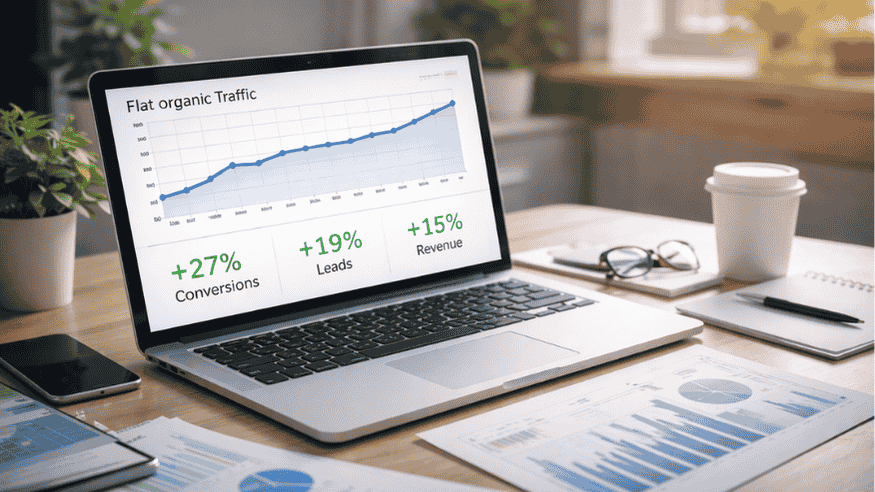
Some of the strongest SEO campaigns I’ve worked on recently showed flat or even declining traffic, yet delivered better leads, higher conversions, and stronger business outcomes than campaigns that chased volume.
Let me explain why.
Flat Traffic Doesn’t Automatically Mean SEO Failure Anymore
Last year, we worked with a service-based business where organic traffic had barely moved for months. In fact, compared to the previous period, sessions were down by around 7–9%.
On paper, it didn’t look impressive.
But when we looked deeper, the picture changed completely:
-
Organic conversion rate increased by 12%
-
Qualified enquiries from organic search grew by 9%
-
Cost per lead from SEO dropped noticeably compared to paid channels
Traffic was flat.
Business impact wasn’t.
This isn’t a one-off case. It’s becoming increasingly common — and AI-driven search is a big reason why.
AI Search Is Changing How Organic Visibility Works
Google no longer works the way it did even two years ago.
With AI Overviews and generative answers, Google now:
-
Synthesises information directly on the results page
-
Pulls insights from multiple sources
-
Answers questions without always sending a click
When someone searches a broad query, they often get what they need without visiting a website at all.
Your content might still be powering that answer.
You just don’t get the click.
From our own analysis across multiple projects, we’ve seen:
-
Click-through rates drop significantly on informational queries
-
Impressions rise while traffic stays flat
-
Branded searches increase weeks after content updates
That’s not SEO failing.
That’s SEO influencing decisions earlier than analytics can easily show.
The Attribution Problem Nobody Talks About
Here’s what usually happens now.
A user:
-
Sees your brand mentioned or summarised in an AI-generated answer
-
Doesn’t click
-
Remembers your name
-
Comes back days or weeks later via branded search, direct visit, or referral
When that happens, Google Analytics doesn’t credit SEO properly.
But the journey still started with search.
When nearly two-thirds of searches can end without a click, judging SEO purely on traffic volume is like judging a shop by how many people look through the window instead of how many walk out with a purchase.
Why Traffic Alone Is No Longer a Reliable KPI
I still track organic traffic. It matters.
But it’s no longer the primary KPI I use to evaluate SEO performance.
Instead, I look at traffic alongside:
-
Conversion rates from organic landing pages
-
Lead quality and intent
-
Assisted conversions
-
Growth in branded search
-
Revenue per organic visitor
In one B2B project, organic sessions dropped by about 11% year over year, but organic-to-qualified-lead conversion improved by over 25%.
From a business perspective, that’s a win.
Shifting Focus to Higher-Intent Searches
One adjustment we’ve made across many campaigns is shifting emphasis away from broad informational keywords and toward middle- and bottom-of-funnel queries.
For example:
-
“What is [service]” brings curiosity
-
“[Service] pricing” brings intent
-
“[Service] vs [competitor]” brings evaluation
These keywords often have lower volume, but they:
-
Convert better
-
Attract more serious buyers
-
Are less affected by AI-generated summaries
If stakeholders still want to see clicks, this approach usually delivers fewer visits, but better ones.
Why Fewer Clicks Can Actually Be a Positive Signal
When content appears in AI Overviews, featured snippets, or rich results, visibility and traffic start to decouple.
We’re seeing:
-
Impressions rise
-
Clicks stay flat
-
Engagement improve
-
Brand recall increase
Your content is being seen, trusted, and used — just not always clicked.
This is especially true for educational and advisory content.
What I Look At When Traffic Stops Telling the Full Story
When traffic alone isn’t enough, these are the metrics I prioritise:
-
Revenue or lead value per organic visitor
-
Conversion rate by landing page
-
Ranking improvements for high-intent keywords
-
Engagement quality (time on page, scroll depth)
-
Assisted conversions from organic search
In one campaign, organic traffic didn’t grow at all for three months — but sales enquiries attributed to organic search increased steadily.
That’s SEO doing its job.
How I Explain This to Clients Without Sounding Defensive
This is the part most people struggle with.
I don’t start conversations with:
“Traffic is flat, but…”
I start with:
“Our organic leads are up X% because we’re attracting more qualified users.”
I also use comparisons:
“Would you rather have 8,000 visitors who leave, or 4,000 visitors who actually enquire?”
That reframes the discussion around outcomes, not charts.
When Flat Traffic Is Actually a Problem
Flat traffic isn’t always good news. Context matters.
It’s a concern when:
-
Rankings are dropping across core keywords
-
Conversions are declining alongside traffic
-
Engagement metrics are worsening
-
Competitors are clearly gaining visibility
Flat traffic with improving quality is healthy.
Flat traffic with declining relevance is not.
Redefining What “SEO Is Working” Really Means
For me, working SEO in 2026 isn’t about maximising traffic.
It’s about:
-
Driving qualified demand
-
Supporting revenue growth
-
Improving efficiency across channels
-
Maintaining visibility in both traditional and AI-driven search
SEO has changed before, and it will change again.
The teams that succeed are the ones who adapt how they measure success — not the ones who cling to outdated dashboards.
If traffic is flat but the business is growing, SEO isn’t broken.
It’s evolving.


Get a Free SEO Audit
Find issues, opportunities, and growth insights with a quick expert audit.
Categories
Explain Your Project
Countries We Serve