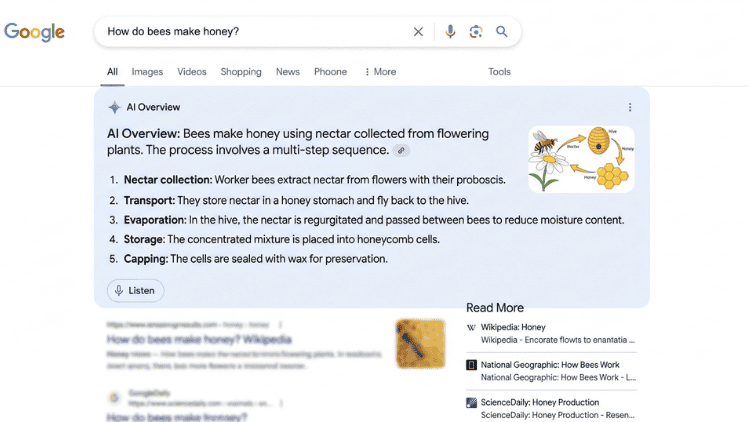
Search optimization is changing rapidly. For years, traditional SEO focused on helping websites rank higher in search engine results pages through keyword targeting, technical optimization, backlinks, and content development. While these fundamentals remain important, the rise of artificial intelligence in search has introduced a new layer of optimization that businesses can no longer ignore.
Today, users are increasingly receiving direct answers from AI-powered search experiences rather than clicking through multiple websites. Platforms such as ChatGPT, Google AI Overviews, Gemini, and Perplexity are transforming how information is discovered and consumed. Before comparing modern optimization approaches, it’s important to understand the foundations of AI SEO and how AI-powered search systems evaluate content visibility.
Understanding Traditional SEO
Traditional SEO focuses on improving a website’s ability to rank within search engine results pages (SERPs). The objective is simple: earn higher rankings for relevant keywords and attract organic traffic through search engines such as Google and Bing.
A traditional SEO strategy typically includes:
- Keyword research
- On-page optimization
- Technical SEO
- Link building
- Content creation
- User experience improvements
- Search engine indexing optimization
For example, if a business wants to rank for “international SEO services,” traditional SEO focuses on optimizing pages, building authority, and improving technical performance so that search engines place the website near the top of search results.
The success of traditional SEO is often measured through:
- Keyword rankings
- Organic traffic
- Click-through rates
- Conversions from search traffic
- Backlink growth
While these metrics remain valuable, search behavior is evolving beyond the traditional search-and-click model.
What Is AI SEO?
AI SEO focuses on improving a brand’s visibility within AI-generated answers, conversational search experiences, and answer-driven search platforms.
Instead of optimizing solely for rankings, AI SEO aims to increase the likelihood that artificial intelligence systems recognize, understand, trust, and reference your content when generating responses.
Modern AI search systems evaluate information differently than traditional search engines. Rather than simply matching keywords, they analyze context, relationships between topics, expertise signals, content structure, and overall authority.
Businesses exploring modern search optimization strategies often begin by understanding the broader foundations of AI-driven search visibility before implementing platform-specific tactics. This shift is creating entirely new opportunities for brands that build strong topical authority and structured knowledge ecosystems.
The Core Difference Between AI SEO and Traditional SEO
The biggest difference lies in how information is delivered to users.
Traditional SEO aims to rank webpages.
AI SEO aims to become the source of answers.
In traditional search, a user enters a query and receives a list of websites. The user chooses which result to visit.
In AI-powered search, users often receive a complete answer directly within the interface. The AI system may reference multiple sources while generating that response.
Because of this change, visibility is no longer measured solely by rankings. Businesses must also consider whether their content is being recognized and incorporated into AI-generated responses.
Content Strategy: Keywords vs Topics
Traditional SEO has historically been heavily influenced by keywords.
A business may create separate pages targeting:
- Best SEO Agency
- SEO Agency Near Me
- Affordable SEO Agency
- SEO Services Company
While keyword targeting remains important, AI systems prioritize deeper topical understanding.
AI SEO encourages businesses to build comprehensive content ecosystems around broader subjects rather than creating isolated pages for individual keyword variations.
For example, a website discussing AI search visibility might also cover:
- Semantic SEO
- Structured data
- Entity optimization
- Topical authority
- Conversational search
- AI search engines
This interconnected approach helps AI systems understand subject expertise more effectively.
How Search Engines Evaluate Content
Traditional search engines rely heavily on ranking signals such as:
- Keywords
- Backlinks
- Page experience
- Internal linking
- Technical performance
AI systems evaluate many of these same factors, but they also emphasize:
- Contextual relevance
- Information completeness
- Topic relationships
- Expertise indicators
- Content structure
- Knowledge consistency
Instead of identifying the single page with the best keyword match, AI models often synthesize information from multiple trusted sources to create comprehensive answers.
This makes content quality more important than ever.
User Intent in Traditional SEO and AI SEO
Traditional SEO often categorizes searches into:
- Informational
- Navigational
- Transactional
- Commercial
AI-powered search goes a step further by attempting to understand conversational intent.
Users now ask questions such as:
- Which SEO strategy is best for a growing business?
- How can I improve AI search visibility?
- What are the risks of ignoring AI search optimization?
These queries require context-aware responses rather than simple keyword matching.
As conversational search continues expanding, businesses must structure content in ways that directly answer real-world questions while maintaining topical depth and accuracy.
Authority Signals Have Evolved
Authority remains critical in both traditional SEO and AI SEO, but the signals have expanded.
Traditional SEO authority often relies heavily on backlinks and domain strength.
AI SEO still values authority, but it also examines:
- Content expertise
- Consistency across topics
- Brand mentions
- Structured information
- Trustworthiness
- Subject coverage depth
A website that consistently publishes high-quality content around a specific topic is more likely to become a trusted source within AI-driven search systems.
This is why topical authority is becoming one of the most important components of modern search optimization strategies.
The Role of Structured Data
Structured data has always been useful for search engines, but its importance is increasing within AI-powered search environments.
Schema markup helps search engines understand:
- Organizations
- Services
- Articles
- FAQs
- Products
- Reviews
When implemented correctly, structured data creates clearer relationships between entities and topics.
These signals improve machine understanding and can support both traditional search visibility and AI-driven content interpretation.
Measuring Success
Traditional SEO metrics often include:
- Rankings
- Traffic
- Clicks
- Impressions
AI SEO introduces additional visibility indicators such as:
- Brand mentions in AI-generated responses
- Presence within AI search ecosystems
- Entity recognition
- Topical authority growth
- Citation frequency
Because AI search is still evolving, businesses should combine traditional SEO metrics with broader visibility measurements rather than relying exclusively on rankings.
Is Traditional SEO Still Important?
Absolutely. AI SEO does not replace traditional SEO. Instead, it builds on top of it. Without strong technical SEO, crawlability, content quality, website structure, and authority signals, AI systems may struggle to understand and trust your content. Traditional SEO provides the foundation. AI SEO expands that foundation into emerging search experiences. Businesses that abandon traditional SEO entirely risk weakening the signals that AI platforms still rely upon when evaluating information sources.
The Future of Search Optimization
Search is entering a hybrid era where traditional search engines and AI-powered experiences coexist.
Users will continue using search engines, but they will also increasingly rely on conversational platforms for research, recommendations, and decision-making.
As this shift accelerates, businesses that invest in both traditional SEO and AI SEO will be better positioned to maintain visibility across multiple discovery channels.
Rather than viewing them as competing strategies, organizations should treat them as complementary components of a broader digital visibility framework.
Conclusion
Traditional SEO focuses on helping websites rank within search results, while AI SEO focuses on helping brands become trusted sources within AI-generated answers and conversational search experiences.
The fundamentals of SEO remain important, but modern search optimization requires a broader approach that includes topical authority, semantic relevance, structured information, and AI-friendly content frameworks.
Businesses that adapt early will be better positioned to capture visibility across both search engines and emerging AI platforms, ensuring their content remains discoverable as search continues to evolve.