
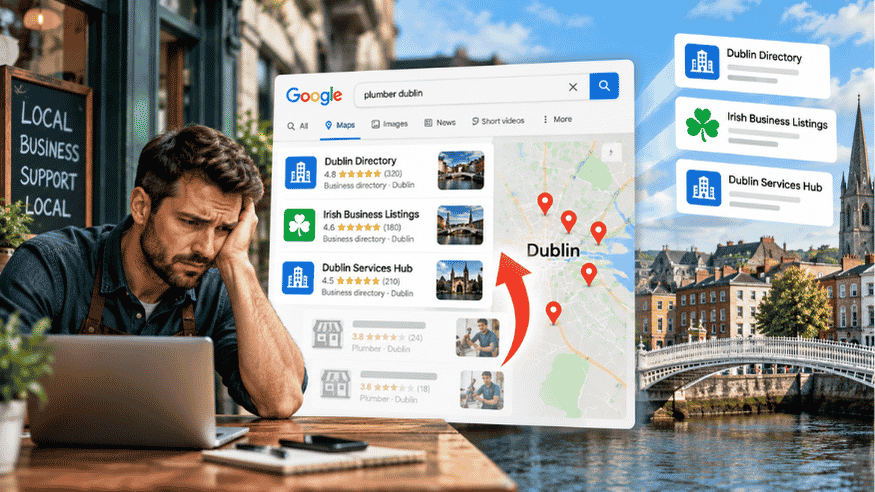
Irish businesses lose local search visibility to national directories and aggregators because those sites have far more authority, more pages and more structured data than a typical small business website. Unless a local business builds its own strong, location-specific presence, Google often prefers to show a directory listing over the business itself.
Search for “plumber Limerick”, “accountant Waterford” or “physiotherapist Galway” and look at what appears. Often it is not the businesses. It is lists, directories and comparison pages sitting above or between them. For a business owner, that is frustrating: you are paying to be listed, yet someone else is capturing the click.
This guide explains why that happens in the Irish market and what you can do about it.
What Is Actually Happening
Directories and aggregators rank for local searches for a few consistent reasons:
- Domain strength. Large listing sites have years of backlinks and millions of indexed pages.
- Scale of local pages. They publish a page for every trade in every town, which matches a huge number of “service + location” searches.
- Fresh, structured data. Reviews, categories, opening hours and addresses are organised in a format search engines read easily.
- User behaviour. Searchers often want to compare options, and Google sees directory pages satisfy that need.
A single small-business website with five pages has little chance of outranking that on its own, unless it is built with a clear local strategy.
Why Dublin Gravity Affects the Rest of Ireland
Ireland is a small market with one dominant centre. Many national platforms and agencies are Dublin-oriented, and a lot of content on the web assumes Dublin as the default location. For businesses in Cork, Galway, Limerick, Waterford, Kilkenny or smaller towns, this creates three problems:
- Location signals get blurred. Generic national pages compete with your local page for the same “service + county” query.
- Less local content exists around you. Dublin has more local publications, communities and citations that reinforce relevance. Regional businesses have to build that deliberately.
- Search intent differs by region. What customers in Galway search for is not always what customers in Dublin search for, yet most directory content is written as if it were the same.
The takeaway is not that regional businesses are disadvantaged. It is that they need to be more intentional about proving local relevance.
The Five Mistakes That Hand Visibility to Directories
1. Relying on a directory listing instead of owning a web presence
A listing is rented visibility. If the platform changes its ranking or pricing, you have nothing to fall back on. Directories should support your presence, not replace it.
2. One generic page for every location you serve
A single “Services” page that mentions ten towns tells Google very little about any of them. Directories win because they have a dedicated page per location and category.
3. Inconsistent business details
If your name, address and phone number differ across your website, Google Business Profile and directories, search engines lose confidence in which version is correct. Small differences, such as “Street” versus “St.” or an old phone number, add up.
4. Neglected Google Business Profile
An incomplete profile, few reviews or no recent activity weakens your chance of appearing in the local map results. Reviews and responses are a visible trust signal to both users and algorithms.
5. Thin local content
Pages that list services without referencing local context, real projects, nearby areas or community relevance read like templates. Search engines can tell.
How to Win Local Visibility Back
Step 1: Fix your foundations
Make sure your business information is identical everywhere, your Google Business Profile is complete with correct categories, and your website loads quickly on mobile. Technical problems quietly undermine every other effort. Our technical SEO services address this layer.
Step 2: Build dedicated location pages with genuinely local content
Each page should reflect real local knowledge: the area’s business landscape, typical customer needs, nearby landmarks or neighbourhoods, and examples relevant to that place. This is exactly how we build our own city pages, such as Dublin, Cork, Galway, Limerick, Waterford and Kilkenny. Each is written around that location rather than copy-pasted with a new place name. You can browse all of them on our Ireland hub.
Step 3: Organise content around topics and entities
Rather than isolated keywords, connect your services, locations and expertise into a clear structure. This is the approach behind semantic SEO, and it helps search engines understand exactly what you do and where.
Step 4: Earn reviews and local mentions
Ask satisfied customers for reviews on Google, respond to every review, and pursue relevant local mentions such as chambers of commerce, trade bodies, local press and community organisations. These signals reinforce your connection to a place.
Step 5: Use directories strategically, not exclusively
Directories are not the enemy. A consistent, accurate listing on respected platforms supports your credibility and gives search engines corroborating information. The goal is to be listed and also to rank on your own domain, so you are not dependent on any one platform.
Step 6: Strengthen your local SEO programme over time
Local visibility compounds. Consistent profile updates, fresh content, review growth and technical care build a stronger position month after month. Our local SEO services are built around this ongoing process.
A Quick Local Visibility Checklist
| Check | Why it matters |
|---|---|
| Name, address, phone identical everywhere | Builds search engine confidence |
| Google Business Profile fully completed | Core requirement for map results |
| Dedicated page per key location | Matches “service + place” searches |
| Genuine local content on each page | Separates you from templated pages |
| Regular review requests and replies | Trust signal for users and algorithms |
| Fast, mobile-friendly website | Affects both rankings and conversion |
| Accurate listings on respected directories | Corroborates your details |
What to Expect
Local improvements can often be seen within a few weeks for profile and technical fixes, while competing for broader keywords against established directories typically takes several months of steady work. No honest agency can promise a specific position, because rankings depend on competition, location and ongoing algorithm changes.
Frequently Asked Questions
Why do directories rank above my business website?
They have stronger domains, more pages and well-structured data. A small site needs dedicated local pages, consistent business details and quality local signals to compete.
Should I remove my business from directories?
Usually not. Accurate listings help credibility. The aim is to build your own presence so you are not relying on them for visibility.
Does my location in Ireland affect how I should approach local SEO?
Yes. Competition, search behaviour and available local citations differ between Dublin and regional areas. Strategy should reflect the specific county or city you serve.
How important are Google reviews for Irish businesses?
Very. Reviews influence both map results and customer decisions, and recent, genuine reviews strengthen trust.
Can a small business outrank a national directory?
For specific, location-focused searches, yes, provided the business has strong local pages, a well-managed profile and good technical health. It rarely happens by accident.
Take Back Your Local Visibility
If directories are taking the clicks that should be going to your business, the fix is a deliberate local strategy rather than more spend on listings. Explore our Ireland city pages to see how we approach each market, or contact us for an audit of where your business stands in local search today.