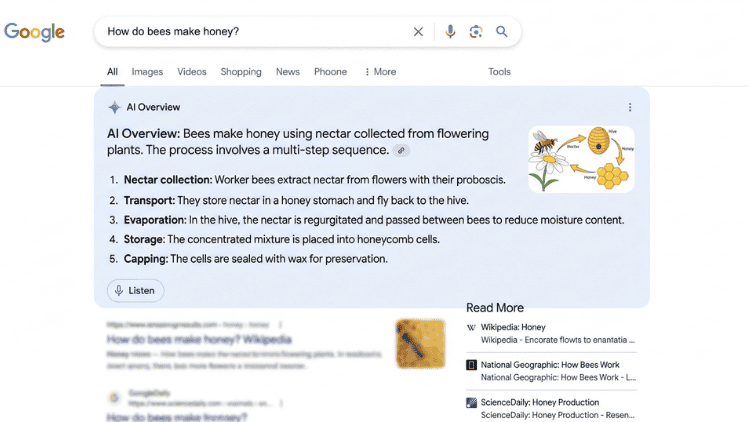


Generative Engine Optimisation (GEO) is the practice of structuring your content, brand and website so that AI-powered search tools such as ChatGPT, Google AI Overviews, Gemini and Perplexity can understand, trust and cite you in the answers they generate. Traditional SEO aims to rank a page in a list of links. GEO aims to make your business part of the answer itself.
If your customers have started asking AI tools questions like “who is the best accountant in Cork?” or “what is the difference between local SEO and technical SEO?”, this shift matters to you. The user may never see a list of ten blue links, and your business is either mentioned in the response or it is invisible.
Why GEO Exists
Search used to be simple: a person typed a query, Google returned ranked pages, and the person chose one. Generative engines changed that flow. They read multiple sources, combine what they find, and write a single answer. Sometimes they link to the sources, sometimes they only mention brand names.
The term “Generative Engine Optimization” was popularised by academic research in 2023 that studied how content could be adjusted to appear more often in generative search responses. Since then, the idea has moved from research into everyday marketing practice.
The practical consequence is simple. Being ranked and being cited are no longer the same thing.
How Generative Engines Choose What to Cite
No one outside these platforms knows the exact formula, and anyone claiming certainty is guessing. But consistent patterns appear in how AI answers are built:
- Clear, extractable answers. Content that states a direct answer near the top of a section is easier for a model to lift and quote.
- Strong entity signals. The engine needs to know who you are, what you do, where you operate and how you relate to other known entities.
- Corroboration across sources. Brands mentioned consistently across reputable websites, directories and reviews are treated as more reliable.
- Structured, well-organised pages. Clean headings, schema markup and logical page structure make content easier to parse.
- Topical depth. Sites that cover a subject thoroughly tend to be treated as more authoritative on it than sites with one thin page.
GEO vs SEO: The Key Differences
| Factor | Traditional SEO | GEO |
|---|---|---|
| Goal | Rank a page in search results | Be cited or mentioned inside AI-generated answers |
| Success metric | Rankings, clicks, organic traffic | Citations, brand mentions, referral traffic from AI tools |
| Content style | Keyword-targeted pages | Direct answers, clear definitions, entity-rich explanations |
| Authority signals | Backlinks, domain authority | Backlinks plus consistent brand mentions across the web |
| Technical focus | Crawlability, speed, indexation | Crawlability plus schema, structured data and clean parsing |
| User journey | Click through to a website | Answer given in the interface, often with zero clicks |
| Measurement | Search Console, rank trackers | Manual prompt testing, AI referral tracking, brand mention monitoring |
Is GEO Replacing SEO?
No. GEO sits on top of SEO rather than replacing it. Most AI search tools still rely on web content that has been crawled, indexed and judged credible, and many of the same signals that help you rank also help you get cited. A site that is slow, poorly structured or thin on content will struggle in both.
Think of it this way: SEO gets you into the pool of sources. GEO increases the chance you are the source that gets used.
GEO vs AEO: Are They the Same Thing?
The terms overlap heavily. Answer Engine Optimisation (AEO) focuses on being the direct answer in featured snippets, voice assistants and AI answers. GEO is often used more specifically for generative AI platforms. In practice, the work is nearly identical, and you do not need two separate strategies. If you want a deeper look at how this works in practice, see our AEO services.
How to Start Optimising for Generative Engines
1. Lead every section with a direct answer
Put the answer in the first one or two sentences, then expand. Models and readers both favour content that gets to the point.
2. Build entity clarity
Make sure your site clearly states your business name, services, location and expertise, and that this information is consistent everywhere you appear online. This is a core part of semantic SEO, where content is organised around topics and entities rather than isolated keywords.
3. Add structured data
Schema markup for your organisation, services, FAQs and local business details helps machines interpret your pages correctly. It is not a magic switch, but it removes ambiguity.
4. Fix the technical foundations
If crawlers cannot access, render or understand your pages, nothing else matters. Speed, clean architecture, proper indexing and mobile usability still come first. Our technical SEO services cover this layer.
5. Earn mentions beyond your own site
AI tools lean on what the wider web says about you. Reviews, directory listings, press mentions, industry associations and guest contributions all strengthen the picture. For location-based businesses, consistent profiles are essential, which is where local SEO work pays off. If you operate in Ireland, our Ireland city pages show how we approach this market by market.
6. Cover topics in depth
Instead of one page per keyword, build connected content that answers the full range of questions around your service. Depth signals expertise.
7. Test your visibility manually
Ask ChatGPT, Gemini and Perplexity the questions your customers ask. Note whether you are mentioned, who is mentioned instead, and which sources are cited. This simple habit shows you where the gaps are.
What GEO Cannot Do
Be wary of promises. No agency can guarantee that an AI tool will mention your brand, because these systems change constantly and are not controllable in the way a paid advertisement is. What you can do is raise the probability by being clear, credible and consistently present across the web.
Frequently Asked Questions
What does GEO stand for? GEO stands for Generative Engine Optimisation. It refers to optimising content and brand presence so generative AI search tools can understand and cite it.
Is GEO different from AEO? They overlap closely. AEO usually refers to winning direct answers across snippets, voice and AI results, while GEO focuses on generative AI platforms. The practical work is largely the same.
Do I still need traditional SEO if I do GEO? Yes. Crawlability, content quality, authority and technical health still determine whether AI tools find and trust your content.
How long does GEO take to show results? There is no fixed timeline. Technical and structural improvements can be picked up relatively quickly, while building authority and brand mentions typically takes several months of consistent work.
Can small local businesses benefit from GEO? Yes. Local businesses often benefit most, because AI tools frequently answer location-based questions like “best electrician near me” by drawing on consistent local profiles and reviews.
Ready to Be the Answer, Not Just a Result?
Search is moving from lists of links to generated answers. If you want a clear view of where your business stands today, explore our full range of SEO services or get in touch for an audit focused on both traditional rankings and AI search visibility.