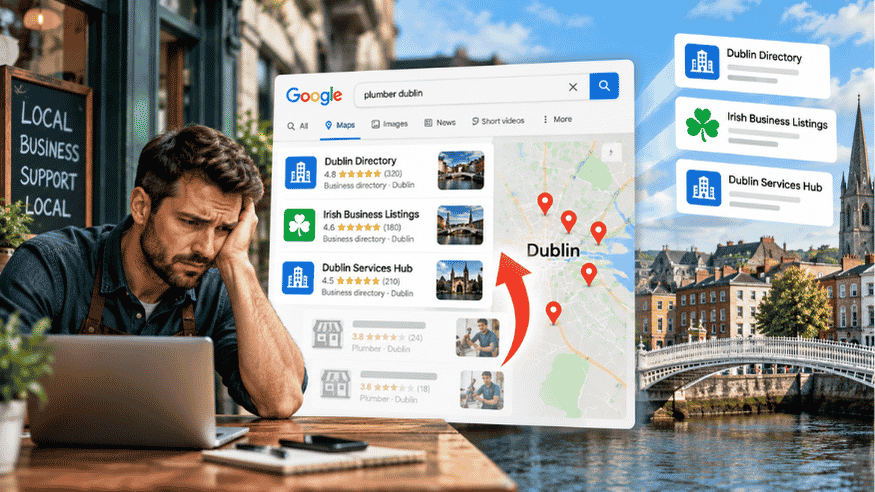

For most Irish service businesses, the Google map pack is worth more than the organic results below it. Three listings, a map, and phone numbers that connect straight to a mobile — it sits above almost everything else on the page, and it captures people who have already decided to buy.
The frustrating part is that map pack rankings work differently from normal SEO. You can have a fast, well-optimised website and still be invisible on the map. Here is what actually drives it in Ireland, and what to fix first.
How Google decides who appears in the map pack
Google ranks local results on three factors, and it says so publicly:
- Relevance — how well your business profile matches what was searched
- Distance — how far you are from the searcher, or from the place they named
- Prominence — how well known and well referenced your business is, online and offline
Distance is the one you cannot change. The other two are entirely within your control, and most Irish businesses are leaving both half-finished.
1. Your primary category matters more than anything else
This is the single most under-used lever in local SEO. Your primary category on your Google Business Profile does more to decide which searches you appear for than any other setting.
A business listed as “Contractor” and a business listed as “Roofing contractor” will surface for very different searches, even if their websites say the same thing. Pick the category that describes what you actually sell most of, not the broadest one available.
Then add secondary categories for your other services — but keep them genuinely relevant. Padding the list with loosely related categories dilutes your relevance signal rather than widening it.
2. Get your Irish address details consistent everywhere
Google cross-references your business name, address and phone number across the web. When those details disagree between sources, confidence in your listing drops, and so does your ranking.
In Ireland there are a few specific traps:
- Eircode — include it, and use the same format everywhere. Many Irish listings omit it entirely, which weakens address verification.
- Phone format — pick one convention and stick to it. Mixing +353 1 234 5678 and 01 234 5678 across directories creates exactly the inconsistency you are trying to avoid.
- Address lines — townland, town and county ordering varies wildly across Irish listings. Choose the version on your Google Business Profile and replicate it exactly.
Audit the obvious places first: Golden Pages, your industry’s Irish trade directories, your social profiles and your own website footer. Fixing ten inconsistent listings is worth more than creating fifty new ones.
3. Reviews are a ranking factor, not just a trust signal
Review count, review velocity and review content all feed into prominence. Two things matter more than most businesses realise:
Steady beats sudden. Twenty reviews arriving over six months looks natural. Twenty arriving in one week looks bought, and Google treats it accordingly.
The words in the review count. When a customer mentions the service and the location — “they fixed our gutters in Kilkenny quickly” — that text becomes part of what Google associates with your listing. You cannot script reviews, and you should not try, but you can ask customers what specifically they were happy with, which tends to produce more descriptive reviews naturally.
Reply to every review, positive and negative. Response rate is visible to both Google and the customer reading it.
4. Build genuine local signals on your website
Your website supports your map pack ranking even though it is a separate property. What helps:
- A dedicated page for each area you genuinely serve, with real content about that market — not the same page with the town name swapped
- Your full NAP details in the footer, matching your profile exactly
- Local business schema markup that confirms your address, service area and opening hours
- An embedded map on your contact page
The location-page point deserves emphasis. Google is explicit that near-duplicate pages created purely to capture location searches are a policy violation. A page about your work in Galway needs to actually be about Galway — the local market, the clients you have there, the conditions particular to that area.
5. Keep the profile active
A profile that has not changed in a year signals a business that may not be operating. Posts, new photos, updated hours and answered questions all indicate an active listing.
This does not require much. A photo of recent work every couple of weeks and a post when something changes is enough. Consistency matters more than volume.
What is different about the Irish market
Three things make map pack SEO in Ireland distinct from the UK or US:
Competition is uneven. Dublin is genuinely crowded — in some categories you are competing with dozens of established listings. Outside Dublin, the picture changes completely. In many regional towns, a well-optimised profile with a dozen good reviews can reach the top three within months, because most competitors have never touched theirs.
Search volumes are smaller. This has a practical consequence: broad terms may only be searched a few hundred times a month nationally. Specific service-plus-town searches are where the actual enquiries come from, and they are far easier to win.
The directory landscape is different. Citation strategies copied from US guides list directories that barely matter here. Irish and industry-specific directories carry more weight than the volume of generic international listings.
What to fix first
If you do nothing else, do these four, in this order:
- Correct your primary category
- Make your name, address and phone identical across every listing you control
- Set up a consistent process for asking customers for reviews
- Add or fix local business schema on your website
These four cover most of what separates a listing that ranks from one that does not, and none of them require a website rebuild.
Map pack visibility works best alongside organic rankings, since the two capture buyers at different stages. If your site has technical problems, those will limit both — technical SEO is usually the prerequisite rather than the next step.
Getting help with local SEO in Ireland
We work with businesses across Ireland on exactly this — see how we approach Dublin, Cork and Galway, or browse all our Irish locations.
If you want an assessment of where your listing currently stands, get in touch.
Written by Gaurav Sharma, founder of MetaEngine. More on his background and work at gauravsharmaofficial.com.